.webp?dpl=dpl_CkLMuQfs4KHnwuPj2rVvn9cpndMj)
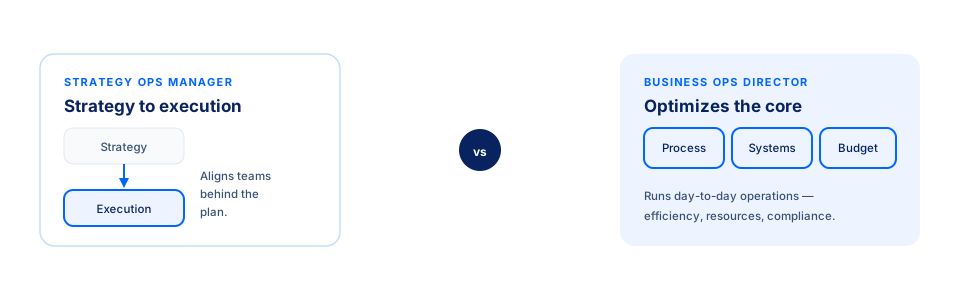
In today's fast-paced business world, understanding the nuances between leadership roles is crucial for career growth and organizational success. Two pivotal positions that often cause confusion are the Strategy Operations Manager and the Business Operations Director. While both play critical roles in driving organizational efficiency, their focuses and responsibilities differ significantly.
This comprehensive guide will unravel the complexities of these roles, helping you understand:
- The distinct responsibilities and focus areas of each position
- Essential skills and qualifications for success
- How these roles fit into the organizational structure
- Career paths and salary expectations
- How to choose the right role for your career or organization
Role Overviews: Bridging Strategy and Execution
Strategy Operations Manager: The Strategic Implementer
The Strategy Operations Manager is a relatively new role, born from the need to bridge the gap between high-level strategy and practical execution. This position is crucial for:
- Translating strategic goals into actionable plans
- Ensuring cross-functional alignment on strategic initiatives
- Monitoring and reporting on strategic progress
- Identifying and resolving roadblocks to strategy execution
Business Operations Director: The Efficiency Optimizer
In contrast, the Business Operations Director role has evolved alongside the growing complexity of business operations. This position focuses on:
- Overseeing day-to-day business operations
- Optimizing internal processes and systems
- Managing budgets and resources effectively
- Ensuring compliance with regulations and policies
Key Responsibilities: Strategy vs. Efficiency
While both roles deal with operations, their focus areas differ significantly:
Strategy Operations Manager:
- Aligns business operations with strategic goals
- Manages strategic initiatives and projects
- Focuses on external product development and market expansion
Business Operations Director:
- Optimizes internal systems and processes
- Ensures smooth functioning of core business operations
- Focuses on technology leadership within the existing framework
Required Skills & Qualifications: The Toolkit for Success
Hard Skills
Strategy Operations Manager:
- Strategic planning and analysis
- Project management
- Data analysis and reporting
- Financial modeling
Business Operations Director:
- Process optimization and improvement
- Budget management and financial control
- Systems implementation and management
- Compliance and risk management
Soft Skills
Both roles require strong leadership and communication skills, but with different emphases:
Strategy Operations Manager:
- Strategic thinking
- Cross-functional collaboration
- Influence and persuasion
- Problem-solving
Business Operations Director:
- Team leadership and management
- Organizational skills
- Decision-making
- Attention to detail
Organizational Structure & Reporting: Where They Fit
The placement of these roles within an organization reflects their distinct responsibilities:
Strategy Operations Manager:
- Often reports to CSO, COO, or CEO
- Collaborates closely with senior leadership
- Focuses on cross-functional strategic initiatives
Business Operations Director:
- Typically reports to COO or SVP of Operations
- More autonomous within their area of responsibility
- Focuses on optimizing specific operational units
Career Paths & Salary Expectations: Charting Your Course
The journey to these roles often follows different paths:
Strategy Operations Manager:
- May come from strategic planning, management consulting, or project management backgrounds
- Often starts in roles like Strategy Analyst or Project Manager
Business Operations Director:
- Often rises through operational roles like Operations Manager or Supply Chain Manager
- Typically has a strong track record in improving operational efficiency
Both roles command competitive salaries, often in the six-figure range, with potential for significant bonuses and equity.
Choosing the Right Role: Aligning with Your Strengths and Goals
For individuals:
- Consider your passion for strategic thinking vs. operational excellence
- Assess your strengths in big-picture planning vs. day-to-day execution
For organizations:
- Evaluate your current priorities: strategic implementation or operational optimization
- Consider the size and complexity of your organization
Ready to build a high-performing team that aligns with your strategic and operational needs? Sign up for Yardstick today and leverage our AI-powered tools to make informed hiring decisions.
Additional Resources: Dive Deeper
To further enhance your understanding and hiring process for these roles:
- Craft targeted interview questions using our interview questions by role section
- Generate custom questions with our AI interview question generator
- Create comprehensive interview guides with our AI interview guide generator
- Learn how to write effective job descriptions with our guide on writing a job description
Conclusion: Empowering Your Leadership Strategy
Understanding the distinctions between Strategy Operations Manager and Business Operations Director is crucial for both career advancement and organizational success. While both roles are essential for a well-functioning organization, they serve different purposes:
- Strategy Operations Managers drive the execution of strategic initiatives
- Business Operations Directors optimize day-to-day business functions
By recognizing these differences, individuals can make informed career choices, and organizations can build balanced leadership teams capable of both strategic innovation and operational excellence.