.webp?dpl=dpl_HUaZ2SP1QxyQ9j92eKjf7G8NYQEC)
Talent pools that are still worth opening.
Organize past candidates, silver medalists, and future-fit prospects into named pools inside your interview-led ATS. The two things a list of names usually loses — the interview evidence on each person, and the upkeep that keeps the pool current — stay attached. So when a role opens, you shortlist from what you already learned.
What a talent pool is.
A talent pool is where you keep the people you'd want to hire before there's a req to put them against. Instead of starting every search from a cold job post, you organize the people you already know into pools — so the first week of a new search is a warm shortlist, not a sourcing sprint. Pools are one part of Yardstick's talent CRM, built into the interview-led ATS.
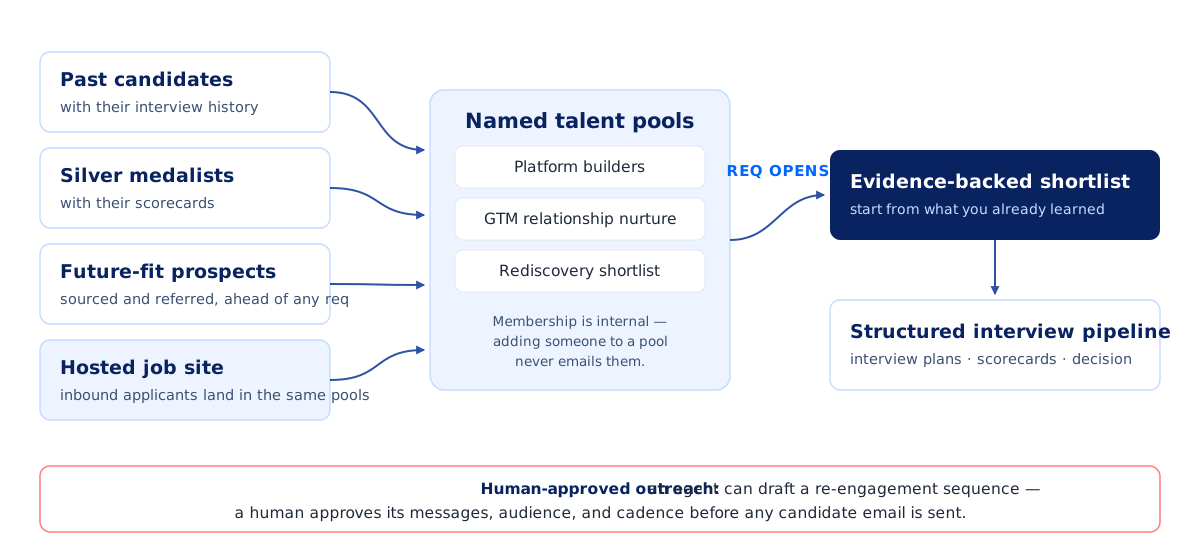
- Past candidates — people who ran your interview process before. Their interview history is the head start.
- Silver medalists — strong finalists who narrowly lost an earlier search, often the runner-up to the person you hired. The highest-signal group, because you've already assessed them.
- Future-fit prospects — people you've sourced or been referred to ahead of any req. Inbound applicants from your hosted job site can land in the same pools.
Pool vs pipeline, in one line: a pool is a group you keep — organized ahead of any opening; a pipeline is a process you run — candidates moving through stages against an open role. In Yardstick the pool feeds the pipeline directly: when a req opens, pool members become candidates in your structured interview process.
| Segment | Who they are | Why they're valuable | What they carry in Yardstick |
|---|---|---|---|
| Past candidates | People who ran your interview process before | You start from what you learned, not a cold record | Interview history and scorecards, in the same system as the pool |
| Silver medalists | Finalists who narrowly lost an earlier search | Already assessed against a bar you trust — the fastest strong shortlist | Scorecards and decision evidence from the search they nearly won, in the same system |
| Future-fit prospects | Sourced people and referrals ahead of any req — plus inbound applicants from the hosted job site | A warm start on searches you haven't opened yet | Source, owner, pool membership, and last touch |
Named pools for every hiring thesis.
A pool in Yardstick is a named workspace: Platform builders, GTM relationship nurture, Rediscovery shortlist. You segment people by role, skill, source, or the hiring thesis they fit — and one person can sit in several pools.
To build a talent pool: create named pools for the roles and skills you hire repeatedly, add past candidates and silver medalists from closed searches, and let sourced prospects, referrals, and job-site applicants land in the pools as they arrive. Pools hold prospects and past candidates side by side, in the same platform as your jobs, candidates, and interviews — so outbound relationships and inbound interest from the hosted job site end up in one place.
Pool membership is internal. Adding someone to a pool organizes them on your side; it never emails or contacts them. Outreach is a separate, deliberate step — and it only happens through a sequence a human has approved.
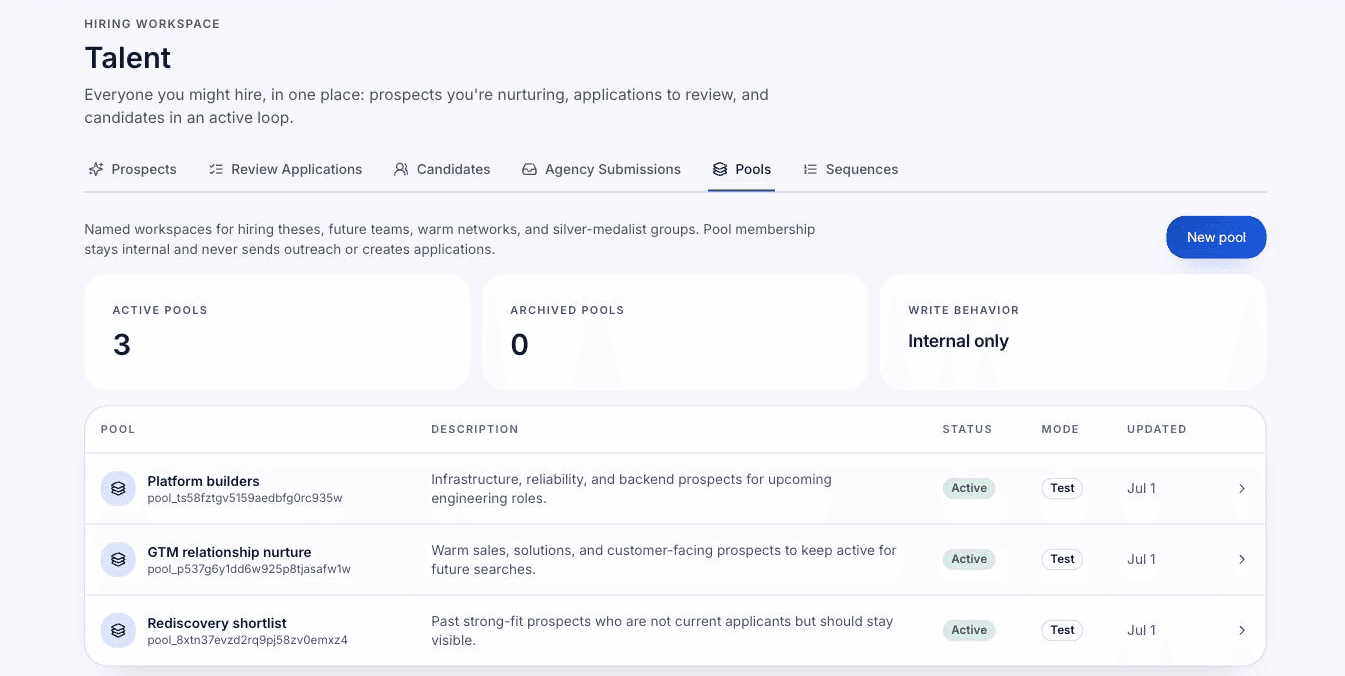
That's the easy part. Creating pools and dropping people in takes an afternoon. Whether a pool is still worth opening a year later is the real question — and it comes down to two things.
A list of names loses two things.
Most talent pools are a list of names that quietly stops being useful. Two things go missing after a search closes, and a pool that loses either one isn't worth opening:
- The evidence gets left behind. The scorecards and interview notes stay in the closed req. The runner-up you'd re-engage in a heartbeat becomes a half-remembered name in a spreadsheet — you'd have to assess them from scratch.
- The upkeep is nobody's job. Tagging, segmenting, and follow-up fall through the cracks, so the pool drifts out of date and the next search starts cold anyway.
Yardstick is built so both survive. The next two sections are how — the evidence stays attached to the person, and the upkeep can be delegated.
Re-engage people you've already assessed.
The strongest people in your pool are the ones you've already interviewed. A finalist who narrowly lost six months ago has something no sourced profile can offer: real interview evidence, scored against your bar by your own team.
Because Yardstick's pools are built into the structured-interview ATS that ran those interviews, that evidence stays in the same system as the pool. When you come back to a silver medalist, you start from their scorecards and interview history — what they showed, where they were strong, why the earlier search went the other way — instead of a cold record. Re-engaging someone you've already assessed is a faster, warmer start than sourcing a stranger.
This is the half a spreadsheet can't hold. A name and an email address don't carry a bar; a scored interview does.
Agents do the upkeep that keeps pools alive.
The other half is staying current. A pool nobody maintains is a pool that starts cold — the segmenting and follow-up that keep it useful are exactly the work that never gets prioritized.
Yardstick is agent-operable, so that upkeep can be delegated. Your AI agent (Claude Code or Codex running the yardstick CLI, or ChatGPT or Claude connected over MCP) can build pools, tag and segment members, flag silver medalists from closed reqs, and draft re-engagement sequences. Agents prepare the work; a human approves anything that reaches a candidate.
So the pool doesn't rot between searches. The evidence stays attached, and the organizing stays current — without it being a standing item on anyone's list.
From pool to shortlist to hire.
When a role opens, you don't start sourcing — you open the pool. Because both halves held, it's ready: pool members become the first candidates in the req, and they run through the same structured interview plan, scorecards, and decision evidence as anyone else. One system carries the person from pool to shortlist to hiring decision.
Re-engagement outreach runs as a multi-step sequence: the messages, the audience, the cadence. Your agent can draft the sequence, and a human approves it before any candidate email is sent. Building sequences and the automated email-send step are both on every account — the approval gate sits in front of every send.
Talent pools themselves are on every account, on pay-as-you-go pricing that bills for active hiring — not seats, headcount, or an annual contract.
Common questions about talent pools.
What is a talent pool?
A talent pool is a group of people you'd want to hire before there's a role to put them against — past candidates, silver medalists from earlier searches, and future-fit prospects — organized so you can start a search warm instead of cold. In Yardstick, pools are named workspaces inside the interview-led ATS, and past candidates' interview history lives in the same system.
What's the difference between a talent pool and a talent pipeline?
A talent pool is a group you keep — people organized ahead of any opening. A talent pipeline is a process you run — candidates moving through stages against an open role. In Yardstick they connect directly: when a req opens, the pool becomes the shortlist that feeds your structured interview pipeline, with stages you define for each role.
Who belongs in a talent pool?
Three groups: past candidates who ran your interview process before, silver medalists — strong finalists who narrowly lost an earlier search — and future-fit prospects you've sourced or been referred to ahead of any req. Inbound applicants from your hosted job site can land in the same pools.
Why do talent pools go stale?
Because the two things that make a pool valuable usually don't survive a closed search: the interview evidence gets left behind in the old req, and the upkeep — tagging, segmenting, follow-up — is nobody's job. Yardstick keeps the evidence attached to each person and lets an agent handle the upkeep, so the pool stays worth opening.
Does adding someone to a talent pool email them?
No. Pool membership is internal — adding someone to a pool organizes them on your side and never contacts them. Candidate outreach only happens through a sequence a human has approved — that approval gate sits in front of every send, on every account.
What is a silver-medalist candidate?
A silver medalist is a strong finalist who narrowly lost an earlier search — often the runner-up to the person you hired. They're the highest-signal people in a talent pool because your team has already interviewed and scored them; in Yardstick, those scorecards live in the same system as the pool.
Are talent pools available on every Yardstick plan?
Yes. Talent pools, talent prospects, the outreach sequence builder, and the automated email-send step inside a sequence are all available on every account, on pay-as-you-go pricing. A human approves a sequence before any candidate email is sent.
Can an agent manage my talent pools?
Yes. Your AI agent (Claude Code or Codex running the yardstick CLI, or ChatGPT or Claude connected over MCP) can create pools, tag and segment members, flag silver medalists from closed reqs, and draft re-engagement sequences. A human approves a sequence before any candidate email is sent.
Start your next search from a warm, evidence-backed pool.
Talent pools are on every Yardstick account — organize past candidates, silver medalists, and prospects now, keep their evidence and their upkeep attached, and shortlist from what you already learned when the role opens.