.webp?dpl=dpl_CEoS6wcaD39NGG2gyZSjANr3BAcG)
The talent CRM built into your interview-led ATS.
Build relationships with future candidates before a role opens — prospects, talent pools, and outreach sequences — in the same structured, human-approved system that runs your interviews and produces your hiring decisions.
What a talent CRM is.
A talent CRM (candidate relationship management) is where you keep track of people you'd want to hire before there's a req to put them against. Instead of starting every search from a cold job post, you build a pipeline of prospects, organize them into talent pools, and stay in touch — so when a role opens, you're reaching out to people who already know you.
It's the top-of-funnel counterpart to an ATS. An ATS tracks applicants against an open role: pipelines, interviews, scorecards, decisions. A talent CRM works one step earlier — the relationships and the pipeline you build ahead of the req. Most teams run these as two disconnected tools and re-key candidates from one into the other. Yardstick runs them as one.
Build the pipeline before the req opens.
The slowest part of most hiring processes is the cold start: a role opens, and only then does sourcing begin. You're starting relationships from zero under time pressure — which is exactly when judgment gets rushed.
Building a pipeline ahead of the req flips that. You start the search warm, with prospects you've already researched and pools you've already segmented. And because Yardstick is evidence-led, the goal isn't volume for its own sake — it's a structured pipeline of the right people, feeding the same interview process that turns every conversation into usable hiring evidence. Relationship-building and structured evaluation become one motion, not two.
How Yardstick's talent CRM works.
Yardstick's talent CRM is four capabilities that share one system of record — and they all flow into the same interview-led pipeline.
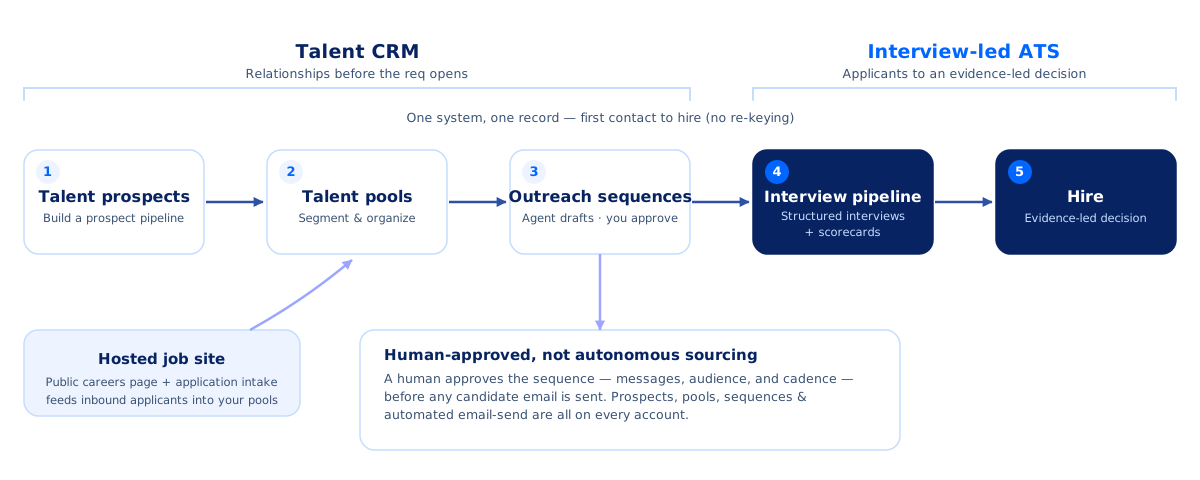
Talent prospects
Build a pipeline of potential candidates — people you'd want to hire before a role is open. Prospects live in the same platform as your jobs, candidates, and interviews, so nothing is re-keyed when a prospect becomes a candidate.
Talent pools
Segment and organize prospects and past candidates into talent pools — by role, skill, location, or how you sourced them — so the right shortlist is ready the moment a req opens.
Outreach sequences
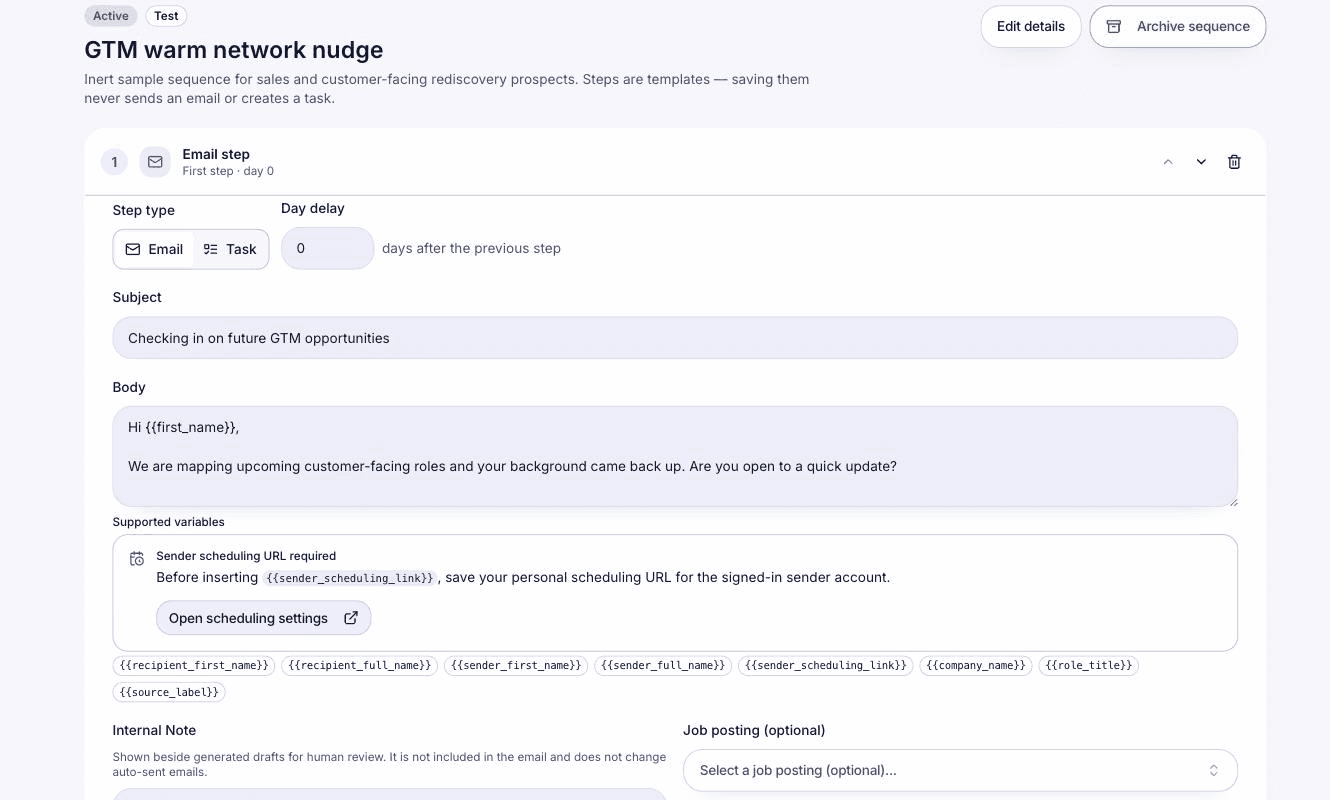
Build multi-step outreach sequences to nurture prospects over time. The sequence builder is available on every account: lay out the messages, the audience, and the cadence. Your agent can draft the outreach — and a human approves the sequence before anything goes out.
Activity timeline and follow-ups
Every prospect has an activity timeline. Log a note, a call, or a meeting, and outreach emails sent through a sequence are added to the timeline automatically. Each prospect shows a last-touch date and a next follow-up, so the whole team can see where the relationship stands.
The hosted job site
Your public careers page and application intake feed inbound interest into the same pools, so outbound prospects and inbound applicants land in one place.
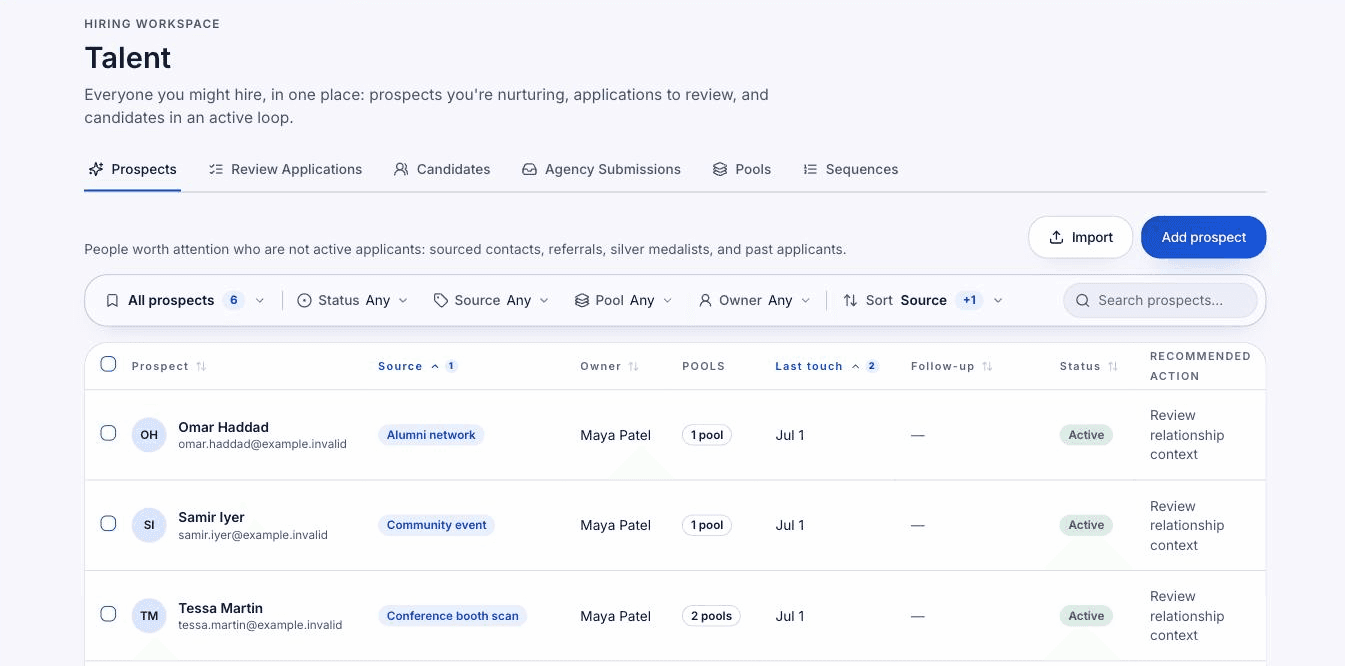
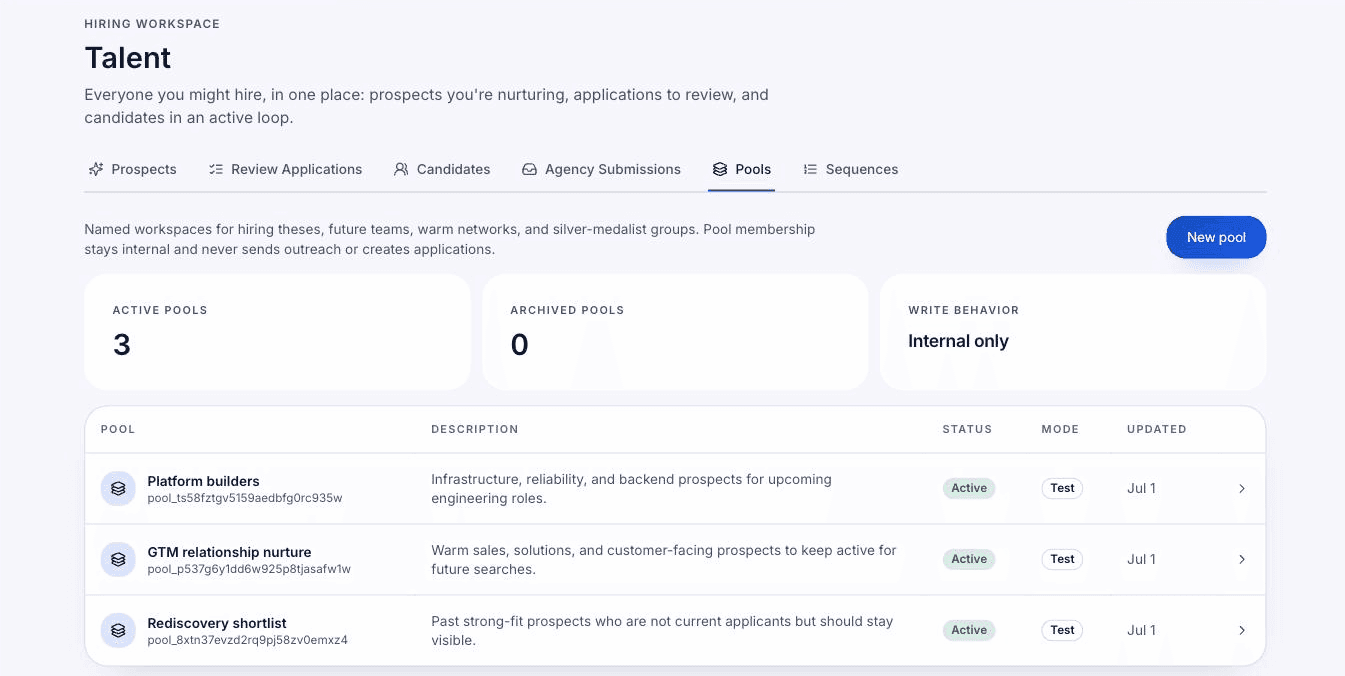
All four flow into the interview-led pipeline: a prospect becomes a candidate, runs through your structured interview plan, and produces the scorecards and decision evidence Yardstick is built around. The hosted job site is the inbound complement — public applications land in the same pools.
Human-approved, not autonomous sourcing.
Yardstick's talent CRM is built for structured, human-approved relationship-building — not autonomous sourcing or mass outbound that fires on its own.
Here's how outreach approval works. Your agent — a coding agent like Claude Code or Codex running the yardstick CLI, or a general assistant like ChatGPT or Claude connected over MCP — can build a prospect pool and draft an outreach sequence for you. But a human approves the sequence — its messages, audience, and cadence — before any candidate email is sent. Once a sequence is approved, sends within it proceed; any ad-hoc, one-off email outside an approved sequence still needs human approval. The agent prepares the work; a person decides what actually reaches a candidate.
One practical note on plans: building prospects, pools, and sequences — and the automated email-send step inside a sequence — is available on every account. The gate that matters isn't the plan; it's approval. A human approves the sequence — its messages, audience, and cadence — before any candidate email is sent, so automated sending stays human-approved, not autonomous.
| Capability | Availability |
|---|---|
| Talent prospects (build a prospect pipeline) | On every account |
| Talent pools (segment prospects + past candidates) | On every account |
| Outreach sequence builder | On every account |
| Hosted job site / public careers page | On every account |
| Automated candidate email send (inside a sequence) | On every account |
One system, from prospect to hire.
Bolt a separate sourcing tool onto your ATS and you get two pipelines, two sources of truth, and a re-keying step every time a prospect becomes a real candidate. Context gets lost exactly where it matters most — the handoff into evaluation.
Because Yardstick's talent CRM lives inside the interview-led ATS, there's no handoff to lose. A prospect you nurtured carries straight into the structured interview plan, the scorecards, and the decision brief — same system, same record, same evidence trail. You're not stitching tools together; you're running one workflow from first contact to hire, on pay-as-you-go pricing that bills for active hiring rather than seats or a locked-in annual contract.
New to the broader model? The ATS for humans and agents page covers the concept, what is Yardstick covers the product, and how it works walks the end-to-end workflow. Still comparing options? The best talent CRMs for startups ranks six of them on one criterion.
Common questions about talent CRMs.
What is a talent CRM?
A talent CRM (candidate relationship management) is the system you use to build and nurture relationships with potential candidates — prospects and talent pools — before a role is open, so you can start hiring from a warm pipeline instead of a cold job post.
What's the difference between a talent CRM and an ATS?
An ATS tracks applicants against an open role — pipelines, interviews, scorecards, and decisions. A talent CRM works one step earlier: the prospects, pools, and relationships you build ahead of the req. In Yardstick they're one system, so prospects flow into the interview pipeline without re-keying.
Does Yardstick's talent CRM automatically email or source candidates?
No. Yardstick is built for structured, human-approved relationship-building, not autonomous sourcing. An agent can draft outreach and build a sequence, but a human approves the sequence — messages, audience, and cadence — before any candidate email is sent.
Are talent prospects, pools, and sequences available on every plan?
Building prospects, pools, and outreach sequences — and the automated email-send step inside a sequence — are all available on every account. A human approves the sequence before any candidate email is sent.
How does outreach approval work?
Outreach uses sequence-level approval: a human approves the sequence once, and sends within that approved sequence then proceed. Ad-hoc, one-off emails outside an approved sequence still require human approval.
Does Yardstick track engagement with prospects, such as emails, calls, and meetings?
Yes. Every prospect has an activity timeline. You log notes, calls, and meetings against the prospect, and outreach emails sent through a sequence are added to the timeline automatically. Each prospect carries a last-touch date, which you can sort the list by, and a next follow-up date that shows up in the owner's tasks.
Build a warm pipeline — and hire from it in one system.
Prospects, talent pools, and human-approved outreach sequences, built into the structured-interview ATS that runs your interviews and decisions.