Review every application against your own criteria

You open a role and eighty applications arrive. Yardstick scores each one against the criteria your team wrote, shows the evidence next to the resume, and leaves the decision to your reviewer.

Your criteria come first.

You write down what the role requires before anyone applies. Every application is then read against that same list, first to last. Same criteria, same questions, every applicant.

Suggested scores your reviewer can interrogate.

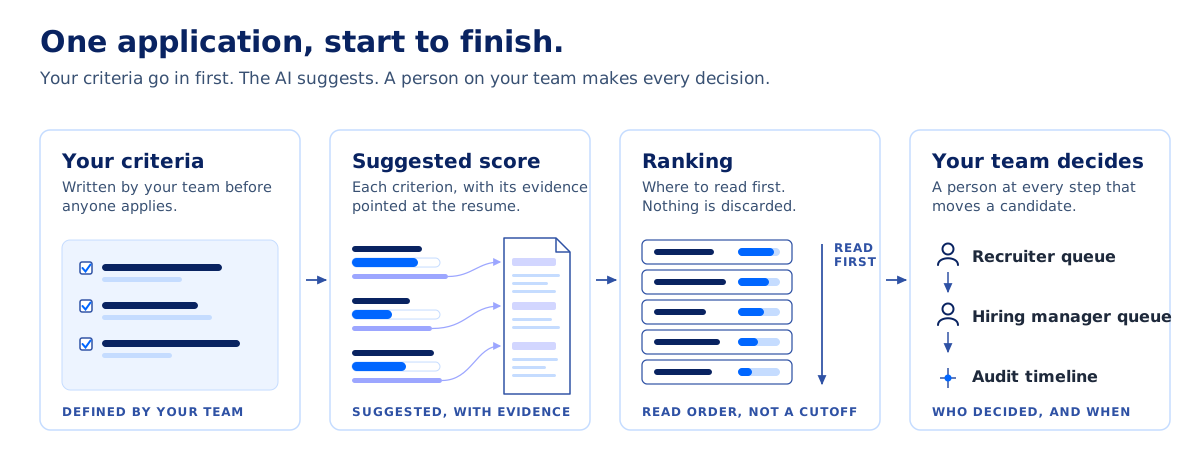
The path of one application in Yardstick: your criteria, a suggested score with evidence beside the resume, a ranking as a reading order with nothing cut off, then your team deciding through the recruiter queue, the hiring manager queue, and the audit timeline.

Evidence per criterion, resume alongside

For each criterion, Yardstick shows what in the application supports or undercuts it, with the original resume in the same view. Your reviewer checks the reasoning against the source and can disagree with either.

Ranking as a reading order, never a cutoff

The ranking tells your team which applications to read first. Nothing below any line is discarded, and no score rejects, advances, or filters out an application.

A review queue for each side of the hire

The recruiter works the incoming volume; the hiring manager sees the applications that need their judgment. Every decision lands on an audit timeline: who decided what, when, and on which criteria.

What the queue looks like.

Yardstick review queue for a Data Scientist role with 20 applicants: AI fit scores group candidates into Strong, Review, and Mismatch, with a per-criterion evidence matrix beside each name and a banner reading 'AI fit is advisory'
A review queue in Yardstick: every applicant scored against the same criteria, with the evidence one click away.

The nightly agent drafts, and holds.

Yardstick’s built-in screen new applicants nightly agent reads new applications overnight against your criteria and prepares rejection drafts, held for review. Your team starts the morning with the reading done, and a person on your team confirms each decision before anything reaches a candidate.

Why this is the fair way to use AI on applications.

Does AI reviewing applications create bias?

The honest risk with any review process, human or AI-assisted, is inconsistency: different applications judged by different standards depending on who read them and when. Yardstick's design addresses that directly. The criteria are job-related, defined by your team, and applied identically to every application. The evidence behind every score is inspectable next to the source document. No automated step rejects anyone. And an audit timeline records every human decision. That is the structure fair-hiring guidance asks for: a rubric before review, the same standards for everyone, and accountable human reviewers.

Who makes the decision?

A person on your team, always. The AI produces suggestions, scores, and rankings that assist the hiring team; it does not decide, and it cannot reject.

Whose criteria are used?

Yours. Yardstick evaluates against the job-related criteria your team defines for the role. There is no hidden universal model of a “good candidate”.

How Yardstick handles the data behind all of this, including the audit trail, is on the security and data handling page.

Review flows into the interview.

The criteria that reviewed the application belong to the same role definition that produced the interview guide. A candidate who advances walks into an interview designed with AI for this specific role, and the evidence trail continues: application review, interview scorecards, and a comparison of candidates on the same scale. Early decisions get more consistent because the whole pipeline asks the same questions of everyone, and that consistency is how Yardstick improves your hiring results.

Yardstick is agent-operable. Your coding agent (Claude Code, Codex) runs the yardstick CLI, or a general assistant connects over MCP, so review state is available where you already work: how many applications came in, which are unreviewed, which are waiting on the hiring manager. Agents prepare and draft; humans approve anything that affects a candidate.

Define the criteria for your open role, and every application that arrives gets read against them, scored with evidence, and queued for a person to decide. Your first 3 Jobs are free.

Common questions about application review.

Does Yardstick use AI to review job applications?

Yes. Yardstick evaluates each application against the job-related criteria your team defines and produces suggested scores and a ranking, with per-criterion evidence shown next to the resume. It is decision support: your team reviews and makes every decision. The generative provider is Google (Gemini API).

Can Yardstick automatically reject applicants?

No. A person on your team confirms every rejection. The screen new applicants nightly agent prepares rejection drafts and holds them for review; a candidate hears from you only through your normal review and send flow.

How do you review a high volume of applications fairly?

Write job-related criteria before you review, apply the same criteria to every application, keep the evidence for each judgment, and have accountable humans make the decisions. Yardstick runs exactly this process: your criteria, applied to every application, evidence per criterion beside the resume, human decisions on an audit timeline.

Do hiring managers and recruiters share one queue?

Each has their own review queue. Recruiters work the incoming volume; hiring managers see the applications that need their call. Handoffs carry the reasoning and every decision is recorded on the audit timeline.

Where does the resume come from?

Applicants attach it on your Yardstick careers page. Yardstick parses it into the candidate record and keeps the original on the record, so reviewers can always check the evidence against the source.